
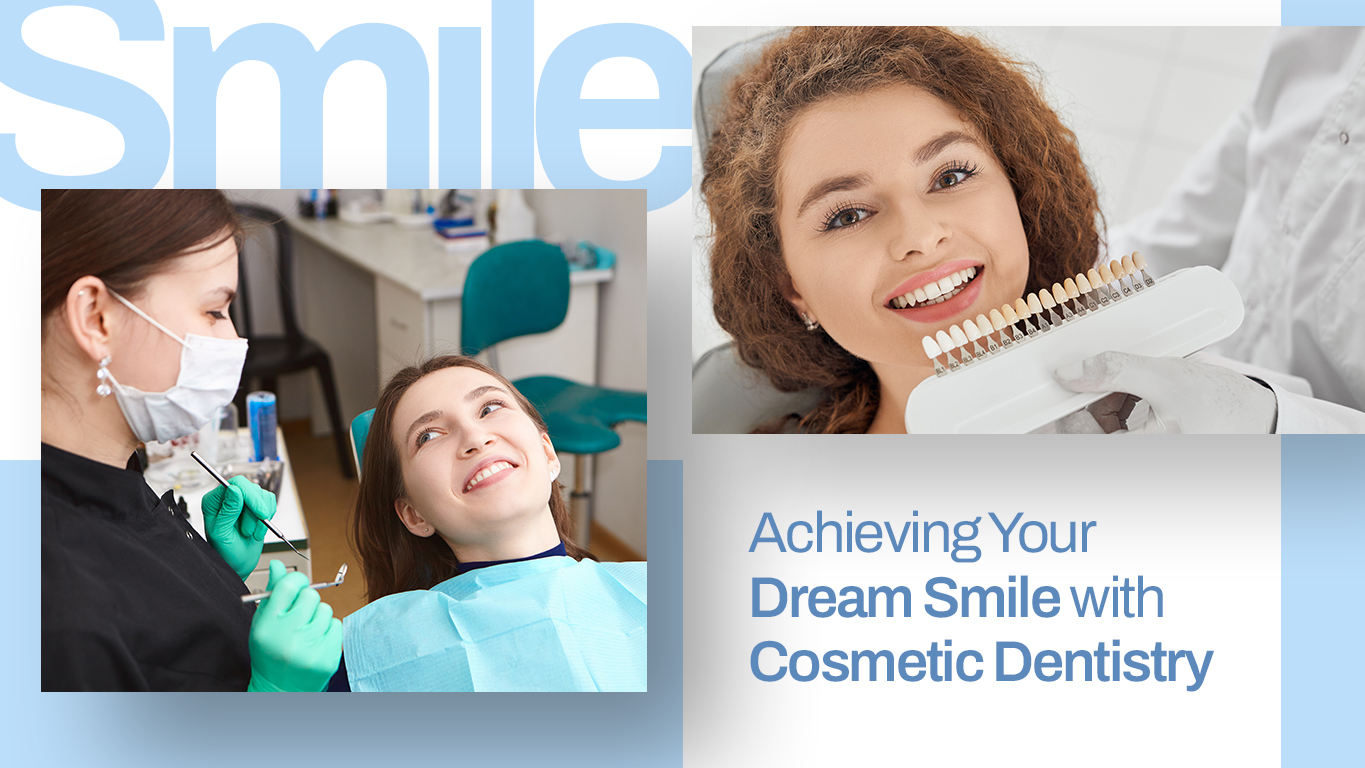
A smile goes a long way! It's usually the first thing a stranger notices, and it can make or break your confidence in a job interview, a first date, or a family portrait. Public attitude studies have always shown that almost everyone (99.7%) sees a smile as a valuable social asset and that about three-quarters feel an unattractive smile can be a hindrance to a person's career. Approximately 96% agree that an attractive smile makes someone more appealing to others.
Those numbers are the reason why so many people go around quietly wishing that there is something that they could do about their teeth to brighten their smiles. The good news is that cosmetic dentistry has never been easier, more comfortable, or more predictable. From discolouration to chips, gaps to worn edges, there's almost certainly a treatment that's right for your teeth, your timeframe and your budget.
Cosmetic dentistry is a speciality that is dedicated to the look of your teeth, gums, and smile. It exists side by side with general dentistry, which should always take priority (a healthy mouth is always first), but it's not just about fixing dental issues, but also about enhancing the appearance.
In reality, the distinction between cosmetic and restorative work can be difficult to make. A fractured front tooth can be protected by a veneer. A bonded repair for a chipped edge makes the tooth look and feel as good as new. This is one of the reasons cosmetic dentistry plays such a significant role in wellbeing: patients regularly report increased confidence and self-esteem, and many patients describe an improvement in their quality of life as soon as they stop hiding their smile in conversation and while taking photos.
The first step is always an honest discussion with a dentist about what is bothering you, what can realistically be achieved, and how the natural tooth structure will respond to treatment.
If you ask patients what they would most like to change about their smile, by far the most common response is a single word: whiter, brighter teeth. However, cosmetic dentistry can be more than people realize, and the type of cosmetic dentistry that is right for the individual will depend on what the issue is. Discolorations, chips, gaps, worn edges, and crooked teeth each require a different treatment, and more often than not, a mouth will have more than one of these at the same time. This is why it is important to have a proper assessment. What looks like a straightforward staining problem may turn out to be worn enamel exposing the darker dentine underneath a difference that changes the recommendation entirely.
There's a reason why teeth whitening is the most popular way to get into cosmetic dentistry. It is not invasive, does not permanently change the tooth, and the results can be dramatic.
An in-chair teeth whitening service is different from anything that you can purchase from the shelf. Most professional systems use a peroxide gel as their active ingredient; the hydrogen peroxide teeth whitening products split into oxygen molecules that penetrate the enamel and dentine to remove the pigmented compounds that cause staining. Since a dentist can use a higher concentration than is allowed in retail products and gums and soft tissues are properly isolated and protected in advance, in-office whitening is much more effective and efficient than over-the-counter at-home treatments. Many patients can expect to see their teeth lighten by several shades in a single visit.
This is a critical safety factor. Higher concentrations of hydrogen peroxide are only available in Australia for use by registered dental practitioners. This is because peroxide gels can be irritating to the gums and cause sensitivity if they are not used with proper protection or assessment. A professional teeth-whitening service also starts with an examination. Untreated decay, gum disease, and cracked fillings all need to be treated before you begin whitening, and a dentist will find these before you do.
The whitening can last for a year or for more than a year, depending on two factors:
It is important to know that whitening can only be applied to the natural tooth structure. Crowns, veneers, and fillings will not change colour, so if you have crowns in the front of your mouth, you may have to get them replaced after bleaching to match your new colour. Also, stains from within the tooth, like tetracycline discolouration or trauma, are not as responsive to whitening. In such instances, veneers may be the better option.
Porcelain dental veneers are thin shells of dental porcelain that are custom-made and attached to the front surface of the teeth. They are engineered to mimic the appearance of natural teeth while simultaneously addressing issues related to tooth shape, size, alignment, and colour, making them a key element in most smile design treatments.
There are two general methods:
Veneers are an option for teeth that are in a bad position, fractured teeth, misshapen teeth, teeth with gaps, stained teeth, and teeth with bite issues. They are durable, extremely stain-resistant, and, if properly cared for and a night guard is used if grinding is an issue, can last for many years.
Dental bonding is often the solution if veneers are too much to commit to. A tooth-coloured composite resin is used in cosmetic dental bonding, which is applied directly to the tooth, shaped by hand, and then hardened with a curing light. The dentist sculpts and polishes the resin so that it blends with the surrounding enamel.
Bonding is easy to understand:
Dental bonding can be a solution for worn teeth, chipped teeth, misshapen teeth, decayed teeth, and small gaps between teeth. The compromise is durability: composite resin is not as durable or as stain-resistant as porcelain, and bonding will typically require repair or replacement sooner than a veneer. That's a fair trade-off for a quick, inexpensive and reversible enhancement and bonding can always be replaced with porcelain later.
Whitening, veneers, and bonding will not solve every cosmetic problem. Other choices may be more appropriate based on your evaluation:
Some of the most dramatic outcomes are achieved by using a combination of treatments, such as straightening the teeth, whitening them, and then finishing them off with bonding or veneers. A top cosmetic dentist will do this in an appropriate order and not individually.
When it comes to “which treatment do I need?” the truth is, it depends on your teeth. Someone with the same grievance as another person about their smile may require completely different solutions. The only way to find out is to get your teeth examined by a professional dentist, talk about the changes you want, and compare all the options together, including the cost, the time involved, and how long the changes will last.
Springvale Dental Clinic is a good place to have that conversation if you're in Melbourne's south-east. The team provides all the cosmetic dentistry services in one place: professional teeth whitening, porcelain dental veneers, cosmetic dental bonding, crowns, bridges, implants, and Invisalign with modern technology and a calm and family-friendly approach. Schedule your appointment and discover your choices for your dream smile.
