One of the most frequently asked questions we receive from many people is about the gap between their teeth. Some have had theirs since they were little and barely think about them. Some people cover their mouths while taking photos, some avoid smiling in meetings, and others have just realized that this is the year to do something about it. The good news is that gaps are very treatable, and there is typically more than one way to close them.
This guide will help you understand why gaps occur, what treatment options are available, how the teeth actually move, and what to expect if you decide to go ahead with treatment.
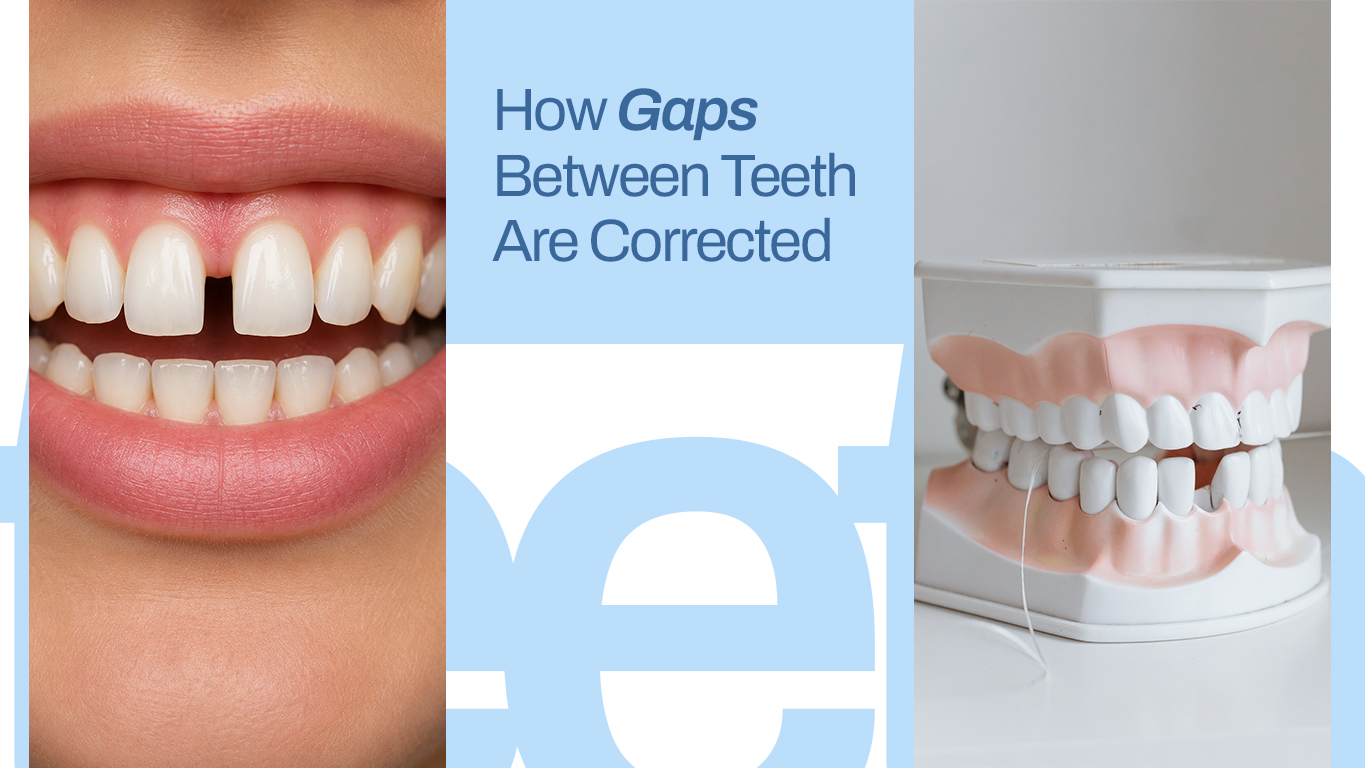
The gap between teeth is clinically known as a diastema. It can occur anywhere in the mouth, but a space between the front teeth is the one people notice the most.
There are several reasons for the formation of gaps:
It's important to understand the cause, as this will impact the correct fix. Closing a gap caused by gum disease without treating the gum disease itself will not hold.
Not always. If there is a small gap that doesn't impact your bite, your gum health or your confidence, then it's not a problem that needs to be solved. Many people have them and like it.
However, treatment should be considered when:
The last point is a legitimate one once since cosmetic issues are real concerns.
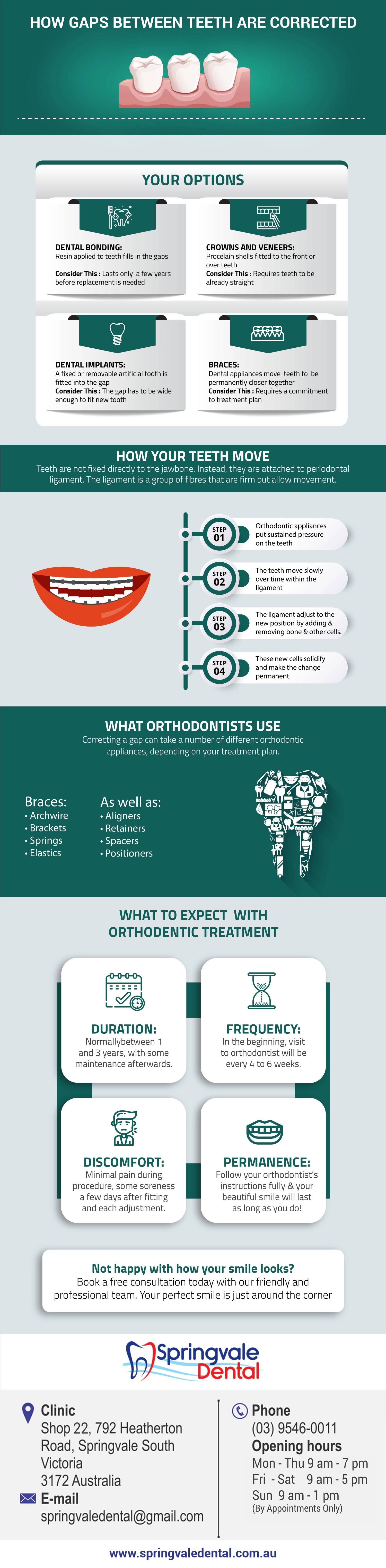
There are four main approaches. They all work in different ways and depend on the gap size, the condition of your teeth and gums, your budget, and the amount of time you have to dedicate to them.
Cosmetic dental bonding involves filling the gap with a tooth coloured composite resin that is applied directly to the teeth on both sides of the gap and shaped to fill the gap. Your dentist will shape the resin, use a curing light to harden it and polish it to match the rest of the enamel.
Why People select it: It is the quickest and the most affordable choice. The majority of cases are completed in one visit and very little or no natural tooth structure has to be removed.
Take this into account: Bonding generally lasts for a few years before repairs or replacement are required. Over time, composite resin can stain and is not as durable as porcelain, and may wear faster in heavy coffee drinkers, smokers and those who grind their teeth.
Bonding can be a great solution for a small to moderate space between front teeth where a quick and conservative solution is desired.
Veneers are thin shells of porcelain that are attached to the front surface of the teeth. Crowns cover the entire tooth. Both can be reshaped to close a gap, and in doing so, correct the colour and shape of the teeth too.
Why people select it: Porcelain is stain resistant and long lasting. Crowns and veneers provide a very aesthetic and uniform look and can correct multiple cosmetic problems simultaneously.
Take this into account: This is best suited for teeth that are already fairly straight. Typically, some enamel must be removed to accommodate the porcelain, and consequently the treatment cannot be reversed. It's a larger investment than bonding, but it will last much longer.
If the gap is due to a missing tooth, the obvious solution is to fill the gap with an artificial tooth. A dental implant is a titanium post that is inserted into the jawbone to serve as the root, with a crown placed on top. This will appear and feel just like a real tooth. When an implant isn't an option, bridges and partial dentures can be used.
Why people choose it: An implant will restore chewing function and prevent other teeth from moving into the space. It is a standalone and permanent solution, which does not require teeth on either side.
Take this into account: The space must be large enough to accommodate a new tooth, and there must be adequate healthy bone to support the implant. It takes several months for the implant to fuse with the bone and for the treatment to be completed, from placement to final crown.
Braces and clear aligners work by moving your actual teeth closer together until the gap is no more. Orthodontics solution is not to cover the gap but to entirely eliminate it.
Why people choose it: This is the only option that closes the gap by moving your own teeth. It is effective for large gaps, multiple gaps and even if the bite requires correction as well. No artificial substance is permanently placed in your mouth.
Take this into account: It takes a commitment to a treatment plan, typically in months to years, not appointments. You will also need to wear a retainer after to maintain the result.
How Your Teeth actually move
Many people are surprised to know that teeth are not permanently fastened in the jawbone. They are held in the bone by the periodontal ligament, which is a set of fibres that are strong but give the tooth a slight range of motion. It is that ligament which makes orthodontics possible.
The following are what occurs during treatment:
What Orthodontists Use
There are many different appliances that can be used to close a gap, depending on the type of treatment you are undergoing. Braces consist of brackets that are cemented onto the teeth, an archwire that connects the brackets and occasionally springs and elastics that are used to apply pressure to the teeth.
In addition to braces, your dentist or orthodontist can use clear aligners, retainers, spacers, and positioners. The combination you need will vary depending on the distance the teeth must move, and what else you may be doing with your bite.
As a rough guide:
The truth is, however, that this is a decision to be made in consultation with a dentist who has examined your mouth, taken X-rays, and evaluated your gums and bone health. Two individuals with a gap that looks similar may require different treatments.
If you have a gap between your teeth and you think about it more than you'd like to, come and talk to us. Our friendly and professional team at Springvale Dental Clinic will examine your teeth, discuss your treatment choices in simple terms, and guide you towards the treatment that will work best for your goals, your time frame and your budget. Whether that turns out to be bonding, veneers, an implant, or braces, you will know exactly what is involved before you commit to anything. You're one step closer to your ideal smile.